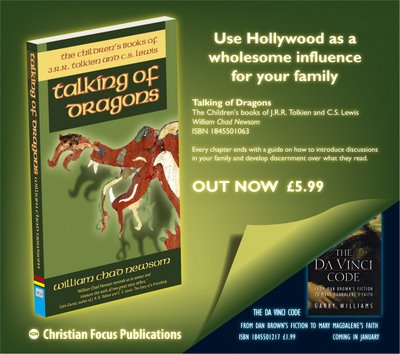
Here's some information on my most recent book:
Talking of Dragons: The Children's Books of J.R.R. Tolkien and C.S. Lewis.
Praise for Talking of Dragons
'This readable book is excellent for parents who wish to have a deep quality of communication with their children. It will also be very useful for librarians and primary school teachers, and those in churches who have responsibilities with children. The author has a firm grasp of the books of Tolkien and Lewis for children, and why they are such powerful examples of Christian writing for today’s world. William Chad Newsom reminds us to savour and treasure the work of two great storytellers who were masters of incarnating Christian meaning in powerful and enduring symbols..'
Colin Duriez, author of
The C.S. Lewis Encyclopedia, J.R.R. Tolkien and C.S. Lewis: The Story of a Friendship, Tolkien and The Lord of the Rings, A Field Guide to Narnia, and
The C.S. Lewis Chronicles.
‘William Chad Newsom has accomplished some very important work with this book. Many modern Christian parents do not grasp the importance of
story to their children's spiritual and moral health. But not just any story will do. Using the stories of two of the twentieth century's most gifted and important story-tellers, C.S. Lewis and J.R.R. Tolkien, Newsom provides very shrewd and practical help to parents who want to grow in their love of story, along with their children.’
Douglas Wilson, minister of Christ Church, Moscow, Idaho, author of
Recovering the Lost Tools of Learning: An Approach to Distinctively Christian Education, Reforming Marriage, and the CD study series,
What I Learned in Narnia.
‘Mr. Newsom offers us many excellent insights into the minds of Tolkien and Lewis. Most importantly, Newsom understands the meaning of story for a Christian…Stories—along with words—contain immense power, and we should use that power, aided by Grace, wisely. When we do so, Newsom reminds us, we pursue the Good, the True, and the Beautiful. And, the words we read—for good or ill—have power…Therefore, we must always be vigilant—as parents, teachers, and Christians—about the books we read, the books our children read, and the books our friends read. As long as we rely on the Grace of the Logos, we will do well and good, and the whole of western and Christian civilization may very well be renewed, refreshed, and reformed. Armed with imagination and devout dedication to Christ, Tolkien, Lewis, and Newsom are leading the way. Swords drawn, let us follow…and slay dragons.’
From the foreword by Bradley J. Birzer, author of
J. R. R. Tolkien’s Sanctifying Myth: Understanding Middle-earth
Christian Focus Publications released Talking of Dragons, my second book, in November, 2005 (U.K.) and December in the U.S., just in time for the release of the much-anticipated film version of
The Lion, the Witch and the Wardrobe. This book is a family-centered introduction to the children's writings of two great authors: J.R.R. Tolkien and C.S. Lewis. Included are chapters on
The Hobbit and
The Chronicles of Narnia, but the book also looks at lesser known children's writings, such as Tolkien's
Roverandom, Mr Bliss, and
The Father Christmas Letters, as well as Lewis'
Letters to Children, and
Boxen. Other chapters explore the friendship between Lewis and Tolkien, their storytelling methods, a Biblical view of Fairy Tales, and more. My publisher retained the services of famed Lewis and Tolkien scholar,
Colin Duriez, to edit the book. Duriez is the author of many books on Lewis and Tolkien, including
The C.S. Lewis Encyclopedia, Tolkien and C.S. Lewis, A Field Guide to Narnia, and
The Inklings Handbook. He also appears on the behind the scenes features of Peter Jackson's
The Lord of the Rings DVDs. Mr Duriez was most helpful and also very graciously provided an endorsement, which is on the cover of the book (and is also printed above). Click the linked title to buy the book at Amazon.com. Below is the publisher's summary of
Talking of Dragons, which appears on the back cover of the book. Following that is an excerpt from the book.
How good are your story-telling skills?
The record-breaking success of the films of J.R.R. Tolkien’s
The Lord of the Rings and the recent release of C.S. Lewis’s
The Lion, the Witch and the Wardrobe has meant that parents, perhaps unfamiliar with these stories, have found themselves in a culture awash with references to ‘Middle Earth’ and ‘Narnia’.
This book is for those who want to know more about the stories of these great authors. Those already acquainted with the writings of Tolkien and Lewis will find it a fascinating insight into their friendship and subject matter but what William Chad Newsom seeks to do is introduce these books to new readers, with a particular emphasis on the role of parents as storytellers.
Each chapter contains advice on how to get the most from each book when parents read them to, or together with, their children.
Lewis once wrote a snippet of poetry to Tolkien in which he refers to the importance of ‘talking of dragons’: of capturing the imagination of young minds. This delightful book explains that if parents want their children to grow up trusting in God then they, too, must ‘talk of dragons’: stretching their children’s imagination outside the materialistic world into a spiritual one.
Full of suggestions and insights
Talking of Dragons will prove a joy to your family as you discover the wonderful tales of Lewis and Tolkien.
Chapter Four
Starting at Home: The Children's Writings of J. R. R. Tolkien
It is true that the age of childhood-sentiment has produced some delightful books (especially charming, however, to adults) of the fairy kind or near to it; but it has also produced a dreadful undergrowth of stories written or adapted to what was or is conceived to be the measure of children's minds and needs.
J. R. R. Tolkien
It seems strange to imagine, but the very idea of children's books is a recent historical invention. The late Kathryn Lindskoog, who wrote many books on the writings of C. S. Lewis, notes that, for most of history, "...there was no such thing as a children's book. There were no children's writers at all. People told stories to children, but no one wrote a storybook for them to enjoy until 250 years ago. Books for children came along like an afterthought in the book world."
There has not always been a "market" for such books, and for a very good reason: storytelling was once primarily the domain of the family. Fathers and Mothers told stories to their children, who in turn told them to their children. Stories were a major part of the culture that was passed down from generation to generation.
This notion of a storytelling culture, handed down from father to son, from mother to daughter, may seem strange to those of us raised in the modern world. After all, our diversions and amusements come packaged according to highly specific demographic categories: Dad reads his mystery thriller, Mom her paperback romance, brother his Harry Potter, and sister her Sweet Valley High book. Each member of the family has his or her own music, movies, clothing styles, magazines, schedule, and life. We are no longer families, with unique family identities; we are merely loosely connected groups of individuals who happen to live under the same roof.
It was not always so. Families once read together, enjoying the same stories, songs, and foods. They were themselves a part of a larger culture that supported them in this, but each family was itself a little culture, developing its own traditions, rituals, and memories. Today, Mom and Dad have no stories that were handed down to them (except maybe their memories of Disney films), and so they have nothing to pass on to their little ones. Today, many children's books are written by "specialists," who may or may not have children of their own. Child psychologists write books that are the product of much research, ensuring that each reader will have age-appropriate storylines, themes, characters, and vocabularies. Never mind that the stories are often as thin as the paper they are printed on: the scientific age has declared its findings, and one discovery is that parents are no longer capable, apart from professional assistance, of telling stories to their children.
One of the goals of this book is to encourage a culture of storytelling in families, and a good way to do this is by highlighting those authors who wrote, not only for "children" as a class, but for specific children, whose names and faces the author knew (usually because they belonged to his own children). This was once more common than now: A. A. Milne wrote his famous Pooh stories for his son, Christopher Robin. George MacDonald, the famous nineteenth century Scottish novelist and fairy-tale writer, read to his children, and his stories, in addition to their wider publication, were handed down through his family as well. His granddaughter remembered, 'My love for my grandfather's Fairy Tales was started at an early age - about five, I think - because my father (Bernard MacDonald) read them to me at night as bedtime stories. As I grew older, the children's books...became very familiar to me and my small friends.'
One of the best examples of a children's writer who wrote primarily for his own children is none other than J. R. R. Tolkien. All of Tolkien's published children's writings were, in their origin, stories he made up for his own children. Indeed, several were not published until after his death, when demand for his writings had increased dramatically. Tolkien made up stories for his children in a variety of situations: when his eldest son, John, could not sleep, he told him stories about Carrots, 'a boy with red hair who climbed into a cuckoo clock and went off on a series of strange adventures.' Every year, as Christmas neared, he would compose a letter from Father Christmas, addressed to the Tolkien children. These letters were posthumously collected and published as The Father Christmas Letters. The Tolkien family's purchase of their first automobile sparked the tale of Mr Bliss, who has a series of misadventures related to his car. When his son, Michael, lost a favourite toy dog on the beach, Tolkien spun a tale about just such a dog who, having been turned into a toy by a wizard, is lost by a little boy on a beach, and then embarks on a variety of adventures on the moon and under the sea. This story was published in 1998, twenty-five years after Tolkien's death, as Roverandom. And of course, the most famous of Tolkien's children's books is the story of Bilbo Baggins, and his adventure recapturing the treasure of the Dwarves from Smaug, the Dragon--a story known to the world as The Hobbit, and which later led to the creation of his master work, The Lord of the Rings.
It is worth noting that Tolkien had no desire to be a 'children's author' as we usually define it, once stating that he had no particular interest in writing for children. Yet, as we have seen, he did have an interest in four children, in particular: John, Michael, Christopher, and Priscilla Tolkien. To them, not to children considered as a target readership, he gave his ever-expanding gift for tale-spinning. But his views on writing for children did change over the years. When he wrote The Hobbit, for example, he was still under what he saw as a modern fallacy - the idea that fairy tales are especially, or perhaps uniquely, for children. In his famous essay, 'On Fairy-Stories'Tolkien attacked that notion, and his more mature reflection resulted in the fairy-story known as The Lord of the Rings.
Tolkien's approach turns modern wisdom on its head: his children's writings would probably be judged, to some extent, as 'over the heads' of most children (sadly, there may some hint of truth in this) because of the vocabulary and perhaps even the themes. On the other hand, The Lord of the Rings, certainly much more of an adult book than its predecessor, and, by the author's own admission, not written for children in particular at all, seems, nevertheless, to hold an appeal for children. Tolkien once wrote that he had heard of even young children reading or listening to The Lord of the Rings, and expressed his hope that it would help build their vocabularies. As a life-long reader of Tolkien, I can testify to both the appeal to children, and the aid to vocabulary. I had read The Hobbit (far and away the favourite book of my youth) some nine times by the time I was twelve, at which tender age I read The Lord of the Rings for the first time.
The worthiness of Tolkien's children's stories is in part a result of the covenantal context that led to their creation - again, writing for the children of one's own blood rather than attempting to break into the market of kid's books. But writing stories for one's own children is counter-intuitive in the Age of Specialists. Whereas modern child psychologists argue, in a sense, from universals to particulars ('this is what children, as a class, want and need; therefore, individual children, whoever they are, will like it'), Tolkien worked from particulars--his own children--to universals--children in general. That is, the stories were a success with John, Michael, Christopher, and Priscilla, who, as normal, typical children, turned out to be very good indicators of what millions of other children would like. Not, of course, that Tolkien told the stories as some kind of advance market research; he just wanted to delight his children. And because this was his aim, he was able to write stories that delighted many others as well.